
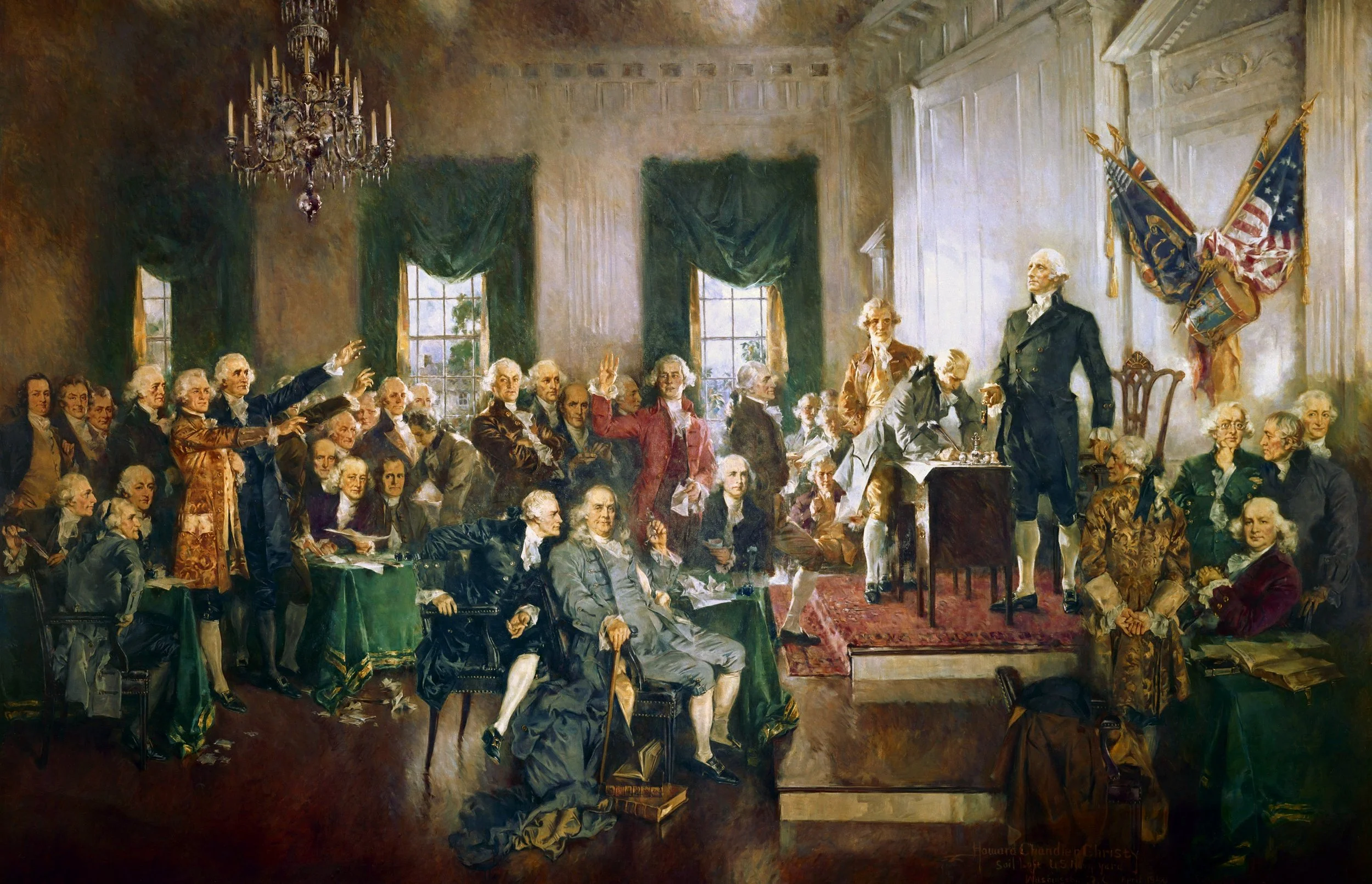
What is Constitution Day?
September 17 is recognized in the United States as Constitution Day and Citizenship Day. On this day, we commemorate the creation and signing of the supreme law of the land and celebrate the privileges and responsibilities of U.S. citizenship, be it for native-born or naturalized citizens.
Federal law requires that all schools receiving federal funds hold an educational program for their students on September 17 of each year.
Discover the Constitution Day Hub
Discover engaging, standards-aligned educational resources at the Constitution Day Hub, brought to you by trusted national organizations that offer high-quality, non-partisan, freely accessible civic education material.
Lesson Plans for the Classroom
From elementary to high school, we have lesson plans on topics appropriate for Constitution Day. Younger students learn about the country's rules and what authority is, while older students dive deep into federalism, the amendments, and more.
Grades 3-5
Civics Inquiry for Foundations of Democracy:
Grades 6-8
Civics Inquiry:
Civics Inquiry for We the People:
Grades 5-12
Civics Inquiry for We the People:
Grades 9-12
Civics Inquiry:
Civics Inquiry for We the People:
The Framers of the Constitution
Fifty-five delegates were present at the Constitutional Convention, which was held in Philadelphia in the summer of 1787. Below is a selection of biographies of different Framers who helped shape America’s constitutional democracy all those years ago.
-
Benjamin Franklin was a Founding Father, inventor, writer, diplomat, and statesman who played a major role in creating the United States. A successful printer and the author of Poor Richard's Almanack, Franklin became one of the colonies' most influential voices. He proposed the Albany Plan of Union, helped organize colonial resistance to British policies, and served in the Second Continental Congress. Franklin helped draft and signed the Declaration of Independence, negotiated crucial French support during the Revolutionary War, and helped secure the Treaty of Paris in 1783, ending the war. He also signed the U.S. Constitution and supported compromise during the Constitutional Convention. Beyond government, Franklin founded important civic institutions, including libraries and the American Philosophical Society, and gained worldwide fame for his scientific discoveries, especially his experiments with electricity.
-
Elbridge Gerry was a Founding Father, signer of the Declaration of Independence, diplomat, governor of Massachusetts, and the fifth U.S. vice president, under James Madison. A strong supporter of American independence, he helped organize military supplies during the Revolutionary War and served in the Continental Congress. Gerry attended the Constitutional Convention and helped shape ideas about checks and balances and the Electoral College, but he refused to sign the Constitution because it lacked a bill of rights and gave too much power to the federal government. He later supported the new government and served in Congress, where he defended states' rights and civilian control over the military. As governor of Massachusetts, his administration became linked to partisan redistricting after a distorted voting district inspired the term gerrymandering. Despite criticism, Gerry spent his career focused on protecting republican government and national unity.
-
Alexander Hamilton was a Founding Father, Revolutionary War officer, and the first U.S. secretary of the treasury. Born in the Caribbean, he became George Washington's trusted aide during the Revolution and later helped shape the new nation's government. Hamilton strongly supported a powerful federal government and played a key role in writing The Federalist, which helped secure ratification of the Constitution. As treasury secretary under Washington, he created the nation's financial foundation by establishing a national bank, funding the national debt, assuming state debts, and promoting manufacturing and trade. His policies strengthened the U.S. economy and federal authority. Hamilton also helped found the Federalist Party. Though controversial, his ideas greatly influenced the structure of American government and finance. He died in 1804 after a duel with Aaron Burr.
-
Thomas Jefferson was a Founding Father, principal author of the Declaration of Independence, and the third president of the United States. Influenced by Enlightenment ideas, he argued that people have natural rights and that government exists to protect life, liberty, and the pursuit of happiness. Jefferson served in the Continental Congress, as governor of Virginia, secretary of state, vice president, and president. He helped establish religious freedom through the Virginia Statute for Religious Freedom, which promoted separation of church and state. As president, he doubled the size of the United States through the Louisiana Purchase of 1803 and supported limited federal government and westward expansion. Jefferson also promoted public education, founding the University of Virginia. His ideas about democracy and individual rights greatly shaped American government, though his legacy is complicated by his ownership of enslaved people.
-
James Madison, known as the Father of the Constitution, played a central role in shaping the U.S. government. Born in Virginia and educated at Princeton, he became a strong supporter of a stronger national government after seeing the weaknesses of the Articles of Confederation. At the Constitutional Convention of 1787, Madison introduced the Virginia Plan and helped design the structure of the federal government. He coauthored The Federalist with Alexander Hamilton and John Jay, defending the Constitution and explaining ideas such as separation of powers and checks and balances. To secure ratification, Madison promised a bill of rights and later wrote the first 10 amendments, protecting freedoms such as speech, religion, and the press. Madison also served as secretary of state under Thomas Jefferson and as the fourth U.S. president, leading the nation during the War of 1812. His work helped define American democracy, constitutional government, and individual rights.
-
George Mason was a Virginia statesman and political thinker whose ideas strongly shaped American government and individual rights. A leader during the Revolutionary era, he wrote the Fairfax Resolves (1774), which challenged British taxation and helped influence the First Continental Congress. In 1776, Mason authored the Virginia Declaration of Rights, a groundbreaking document that inspired the Declaration of Independence and later the U.S. Bill of Rights. He also helped draft Virginia's constitution. At the Constitutional Convention in 1787, Mason argued against a powerful central government and warned about the dangers of concentrated political power. He refused to sign the Constitution because it lacked a bill of rights and objected to compromises involving slavery and federal authority. His "Objections to the Federal Constitution" became a key Anti-Federalist argument and helped lead to the adoption of the Bill of Rights, securing protections for individual liberties.
-
Gouverneur Morris was a statesman, constitutional framer, and influential architect of early American government. Born into a wealthy New York family, he was educated at King's College (now Columbia University). He supported American independence and served in the Continental Congress, where he signed the Articles of Confederation. Morris also helped create the nation's decimal coinage system and drafted plans for the Bank of North America. At the Constitutional Convention of 1787, Morris was one of the most active delegates, speaking more often than any other member. As part of the Committee on Style, he wrote much of the Constitution's final wording, including the famous phrase "We the People," emphasizing national unity and popular sovereignty. He also helped shape the presidency and proposed the Electoral College system. Later, Morris served as U.S. ambassador to France during the French Revolution and as a U.S. senator from New York.
-
George Washington was the commander of the Continental Army during the American Revolution and the first president of the United States. Born in Virginia, he gained military experience in the French and Indian War before leading American forces in the Revolutionary War, including the decisive battle at Yorktown in 1781 and final victory over the British. After the war, Washington strengthened republican government by voluntarily giving up military power and rejecting calls to become king. He presided over the Constitutional Convention of 1787, helping to legitimize the new Constitution, and was unanimously elected the nation's first president in 1788. Washington established key precedents for the presidency, including the cabinet system, the title "Mr. President," executive authority, and the tradition of a two-term limit. He promoted national unity, upheld federal authority during the Whiskey Rebellion, and warned against political parties and foreign alliances in his "Farewell Address."
The Constitution EXPLAINED!
Learn about key aspects of the U.S. Constitution in everyday language. This series of 35 videos was created by the Center for Civic Education in partnership with iCivics and constitutional scholar Linda R. Monk, JD, to make our nation's founding document accessible to everyone.
About the Constitution
-
The Preamble to the Constitution is the mission statement of the United States government. In just one sentence, the Preamble expresses the source of the Constitution’s power and summarizes its goals.
-
The Constitution was created by a convention that met in Philadelphia in May 1787 to amend the Articles of Confederation, the nation’s first constitution.
-
The structure of the Constitution is built on three key principles: federalism, separation of powers, and checks and balances.
The Three Branches of Government
-
Article I of the Constitution lays out the structure of the legislative branch, the branch that makes the laws. It also dictates how members of the House of Representatives are elected, and the 17th Amendment changed the process of electing senators.
-
Article I of the Constitution grants powers to Congress and also sets limitations.
-
Article II of the Constitution creates the office of the president of the United States (POTUS), determines how they are selected, and states the oath of office where they swear to “preserve, protect, and defend the Constitution of the United States.” The 12th Amendment changed how the vice president is selected.
-
Article II of the Constitution gives powers to the president with the responsibility to “take care that the laws be faithfully executed,” including the most important – the Constitution itself.
-
The 20th, 22nd, and 25th Amendments changed the office of the president.
-
Article III of the Constitution established judicial power – including judicial review – and life tenure for judges. Alexander Hamilton believed the judiciary would be "the least dangerous branch" of U.S. government.
Other Articles of the Constitution
-
Article IV of the Constitution regulates the relationships between the states.
-
The Supremacy Clause in Article VI makes federal law “the supreme law of the land” over state law.
Amendments and Ratification
-
Article V allows for peaceful change through constitutional amendments. The Twenty-Seventh Amendment, proposed in 1789 and ratified in 1992, is the last Amendment to the Constitution—so far.
-
In order to officially become law, the Constitution had to be ratified, or approved, by the states.
The Bill of Rights
-
The First Amendment protects freedom of religion by preventing an established or official faith and supporting free exercise of religion.
-
The First Amendment protects freedom of speech and of the press to help Americans govern themselves.
-
The First Amendment protects the people's freedoms to gather and to petition the government.
-
The Second Amendment protects the right to keep and bear arms.
-
The Third and Fourth Amendments protect privacy in the home.
-
Due process of law under the Fifth Amendment requires fair rules in the legal system.
-
Due process of law under the Fifth Amendment helps protect fairness in the criminal justice system.
-
The Sixth and Seventh Amendments protect many of the rights needed to have a fair trial.
-
The Eighth Amendment limits unjust and inhumane punishments for crimes.
-
The Ninth Amendment protects rights that are not specifically listed in the Bill of Rights.
-
The 10th and 11th Amendments protect the powers of the states.
Reconstruction Amendments
-
The 13th Amendment abolished slavery in the United States.
-
The 14th Amendment defined citizenship in the Constitution.
-
The 14th Amendment nationalized the Bill of Rights.
-
The 14th Amendment applies equal protection of the law.
-
The 15th Amendment prohibited discrimination in voting based on race.
Other Amendments
-
The 16th Amendment made income taxes an official part of the Constitution.
-
The 18th and 21st Amendments regulated the production, sale, and transportation of alcohol in the United States.
-
The 19th Amendment protected the right to vote for women nationwide.
-
The 23rd Amendment allowed citizens in the nation’s capital to vote for president.
-
The 24th Amendment banned poll taxes in federal elections.
-
The 26th Amendment protected the right to vote for citizens between the ages of 18 to 21.
The Constitution EXPLAINED was made possible by the generous support of Kenneth C. Griffin.
There's no substitute for the original. When exploring the Constitution and the themes of citizenship and democracy, encourage students to dive into the primary documents from the Constitution to the writings of the Federalist to the many amendments.
Primary Documents
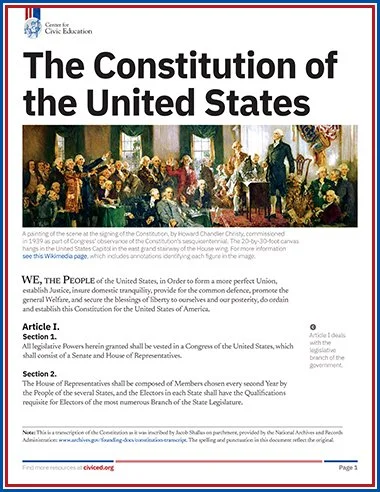
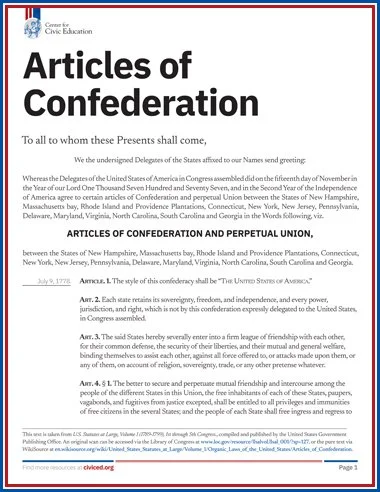
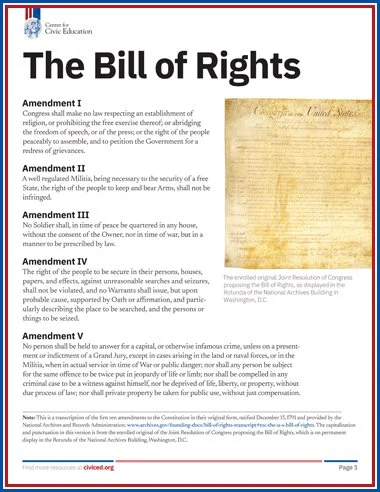


From its drafting through ratification to its various amendments, the U.S. Constitution has changed along with our understanding of it. Below are a few of the key milestones in that history.
The Constitution Over Time
September 17, 1787: The Constitution is signed in Philadelphia
•
December 7, 1787: Delaware is the first state to ratify the Constitution
•
June 21, 1788: Constitution is ratified by the required 9 of 13 states
•
March 4, 1789: The first Congress meets under the new Constitution
•
September 25, 1789: Congress sends twelve amendments to the states for ratification
•
May 29, 1790: Rhode Island ratifies the Constitution, the last state to do so
•
December 15, 1791: Bill of Rights is adopted with Virginia’s ratification
•
September 17, 1787: The Constitution is signed in Philadelphia • December 7, 1787: Delaware is the first state to ratify the Constitution • June 21, 1788: Constitution is ratified by the required 9 of 13 states • March 4, 1789: The first Congress meets under the new Constitution • September 25, 1789: Congress sends twelve amendments to the states for ratification • May 29, 1790: Rhode Island ratifies the Constitution, the last state to do so • December 15, 1791: Bill of Rights is adopted with Virginia’s ratification •